

A company that buys a vehicle becomes its registered owner, and the file that follows is the same registration file a private buyer submits with three differences: who signs it, which tax number is quoted, and what has to happen when the vehicle is later sold. This guide sets out the paper a district office expects from a firm, how the fee and advance tax are built, and the points where a company purchase goes wrong before the vehicle ever reaches the inspector.
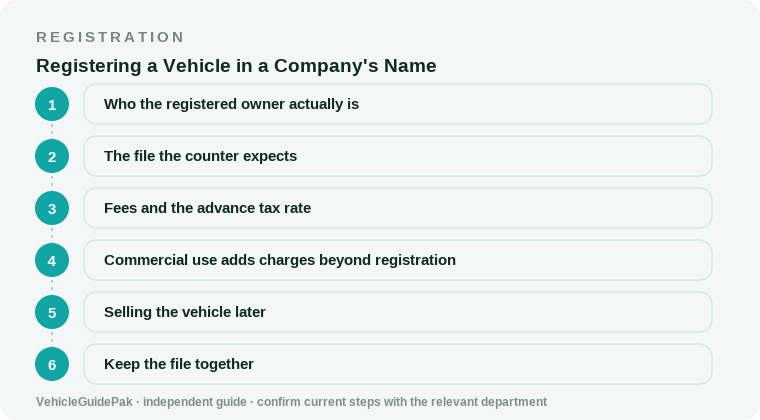
Who the registered owner actually is
The record carries the company name and its National Tax Number. A director, a fleet manager or an accounts officer may sign, but none of them owns the vehicle. Authority comes from a resolution of the board or a letter signed by an authorised officer, and that paper is what lets the counter accept a signature from someone whose CNIC does not match the owner field.
This matters at every later step. A change of chief executive leaves the vehicle record untouched, and a director who leaves does not take the car with him. When the company is wound up, the vehicle is an asset in the winding-up and must be transferred out before the entity disappears.
The file the counter expects
The published lists from provincial excise departments are written for an individual, so they name the CNIC and the owner’s proof of residence. A firm supplies the equivalent for the entity, plus the authority for the person standing at the window. Most district counters ask for the following, and it is worth confirming the list by phone before the invoice is issued.
| Document | Issued by | What the counter checks |
|---|---|---|
| Form F, application for registration | Excise office or portal | Company name, engine and chassis numbers match the invoice |
| Sale invoice and sale certificate | Dealer or manufacturer | Buyer named as the company rather than the director |
| Incorporation certificate | Securities and Exchange Commission of Pakistan | Company exists and the name matches the invoice |
| NTN certificate and active taxpayer status | Federal Board of Revenue | Rate of advance tax and filer status |
| Board resolution or authority letter | Company secretary | Named signatory, vehicle description, scope of authority |
| CNIC of the signatory | NADRA | Signature matches the resolution |
| Proof of company address | Utility bill, lease or ownership deed | Address within the registering district |
| Customs papers, for imports | Pakistan Customs | Bill of entry, bill of lading, duties paid |
The invoice is the weak link in most company purchases. A dealer writes the invoice to the person standing in the showroom, which is often a director paying from his own card. If the invoice names him rather than the company, the registration file cannot be built in the company’s name without a correction or a fresh sale document, and the vehicle sits idle while that is sorted out.
In Islamabad the process runs through physical inspection, a report on Form F by the excise inspector, data entry, payment at the window and a registration receipt, with the plate fee paid separately in cash. The ICT registration page sets out that sequence. The same steps apply to a company, with the resolution added to the file.
Fees and the advance tax rate
Registration cost is several charges added together. Islamabad states the formula as registration fee plus advance tax plus token tax plus income tax, with professional tax added for a commercial vehicle. Khyber Pakhtunkhwa publishes its registration fee as a percentage of vehicle value: one per cent for motorcycles and for cars and pickups up to 1300cc, two per cent from 1300cc to 2500cc, four per cent above 2500cc, and one per cent for trucks, buses and commercial vans.
Advance tax under section 231B of the Income Tax Ordinance is collected at registration, and the rate depends on engine capacity and on whether the buyer is on the active taxpayer list. Khyber Pakhtunkhwa publishes both columns. For a car between 1301cc and 1600cc the collection is Rs 50,000 for a filer and Rs 150,000 for a non-filer; between 1801cc and 2000cc it is Rs 200,000 against Rs 600,000. The gap between the two columns is the most expensive detail in the file, and it is worth confirming at the counter which column applies to a company purchase before the challan is generated.
Registration has a deadline. Khyber Pakhtunkhwa requires registration within sixty days of purchase or import and applies a penalty after that, stepping up once the default passes six months. Islamabad applies a late fee after sixty days from the invoice date. Both clocks start with the document, not with the day somebody in accounts remembers the vehicle.
Commercial use adds charges beyond registration
A company van used for deliveries, a staff bus or a vehicle let out for hire carries more than a private car. Islamabad adds professional tax to the registration formula for a commercial vehicle. Fitness certification runs on its own inspection cycle, and a route permit is needed where the vehicle operates for hire. A lapse in either stops the vehicle working.
If the vehicle is bought on bank finance, the financier’s interest is endorsed on the record. The registration itself proceeds, but the bank’s name will sit on the file until a clearance letter is filed, and a sale before that point will be refused at the counter.
Selling the vehicle later
A company sale needs the same authority paper as the purchase: a resolution naming the vehicle, the buyer and the signatory. The transfer fee is calculated on engine capacity, and advance tax is collected again on transfer where the vehicle is within five years of first registration, with ten per cent depreciation applied for each year in Islamabad. Outstanding token tax, challans and any lien have to clear before the counter accepts the file.
Where the company is being struck off or merged, transfer the vehicle first. A dissolved entity cannot sign a transfer order, and recovering a signature from a struck-off company is a legal problem rather than an excise problem.
Keep the file together
Store the resolution, the invoice, the registration certificate or smart card, the tax challans and the clearance letter in one folder, and note the registration and token tax dates against the vehicle in the company calendar. A fleet of three or four vehicles is enough for dates to slip, and a lapsed token tax period on a company car surfaces at the worst moment: at a checkpoint, at a fitness inspection, or in the middle of a sale that the buyer has already financed.