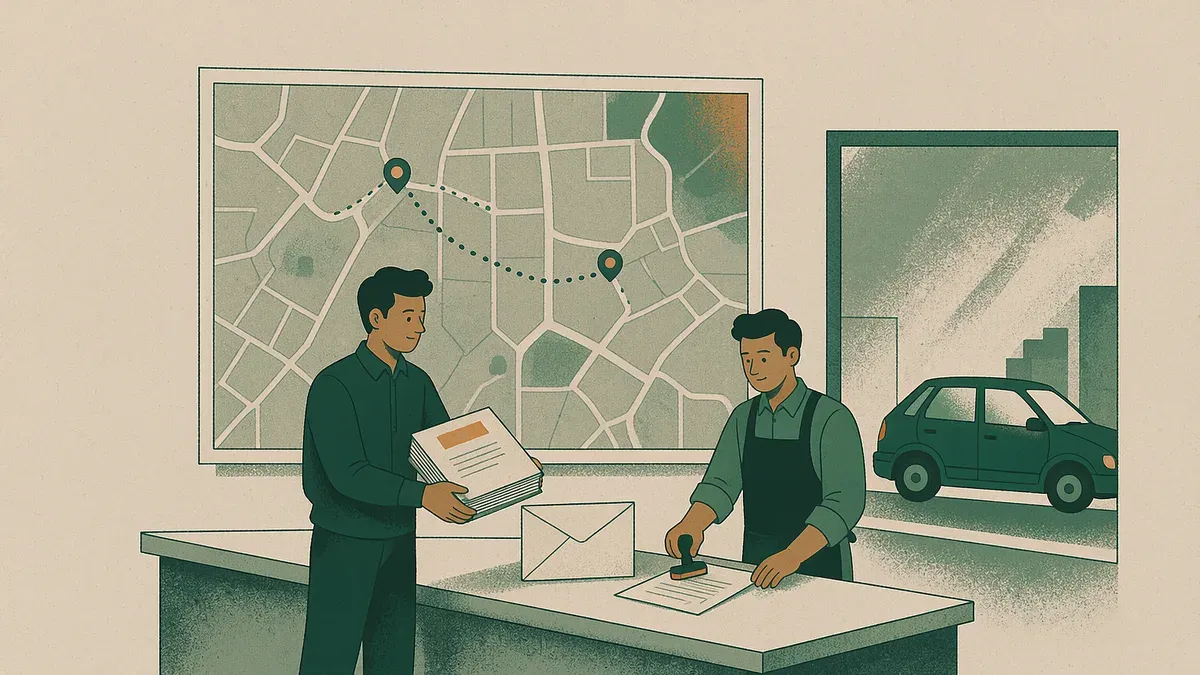
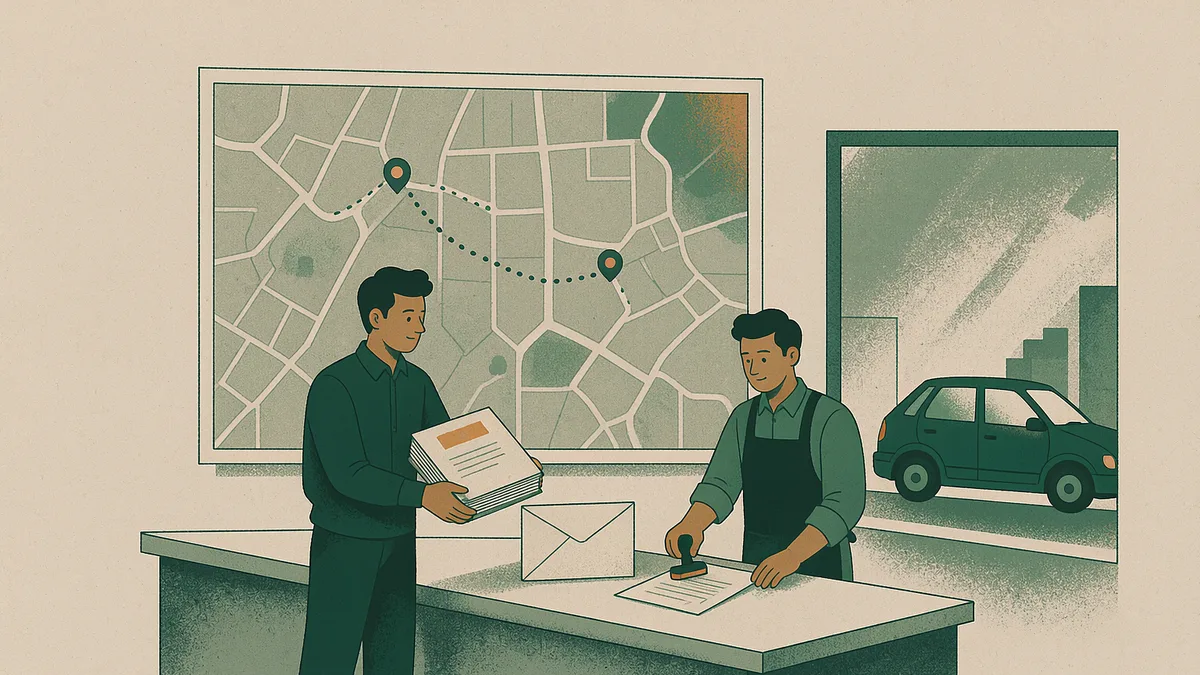
A car sold in Peshawar to a buyer in Karachi changes hands in an afternoon. The registration record changes weeks later, in an office chosen by where the vehicle is registered rather than where the money moved. Until that record changes, the seller stays liable for the tax and challans attached to the number. This guide covers the sale between two cities: which office takes the application, what travels with the file, what an absent owner has to sign or verify, and what the new office checks before it prints a card.
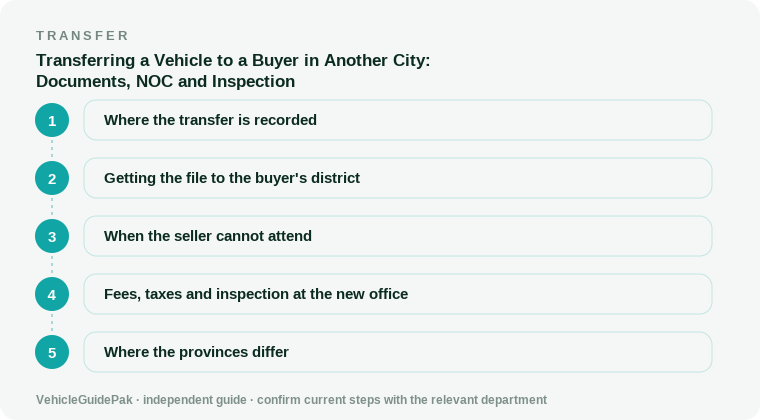
Where the transfer is recorded
A vehicle belongs to the district that registered it. The sale address and the place where the car will be parked do not change that. Three situations follow from it.
| Situation | Where the application goes | Extra papers | What changes |
|---|---|---|---|
| Same district | The excise office that already holds the record | Standard transfer papers | Owner field and smart card |
| Same province, different district | The buyer’s district office, once the file has moved | NOC from the registering district, complete file, proof of residence | Owner field and smart card |
| Different province | The new province’s registering authority | NOC, re-registration application, fresh inspection | New registration number and plates |
Islamabad states the out-of-district case plainly on its vehicle transfer page. A vehicle registered in another district needs proof of residence in the capital, a photocopy of the registration book, a photocopy of the complete registration file, the original file where the department has returned it, and an NOC from the excise department that holds the record. If the applicant lives with someone else and has no bill in their own name, that person has to appear in person and swear an affidavit that the applicant resides there.
Read that list before agreeing a price. Each item takes time to obtain from another city, and the NOC comes from the office that holds the file, which has little interest in speeding up the departure.
Getting the file to the buyer’s district
The registration book or smart card is the document that proves the vehicle exists on the record. The file is the bundle behind it: application forms, invoices, tax receipts, inspection reports and any lien papers. Some districts will accept photocopies at the first counter and call for the original later, and some will not open a case without the whole bundle. Ask the receiving office which one it wants before the seller couriers anything.
- Get the NOC first. It tells the new district the old one has no objection, and most offices will not open a case without it.
- Keep a complete photocopy of the file before it leaves. If a page goes missing in transit, the copy is what the two offices will use to reconstruct it.
- Send originals by a service that gives a tracking number and requires a signature. Hand them over against a written receipt that lists each document.
- Check the token tax position in the old district. Unpaid tax is collected against the vehicle, and the new office will add it to the challan rather than let the transfer proceed with a gap.
- Confirm the seller’s CNIC and the name on the registration book match exactly. A spelling difference that was never corrected becomes a correction case in the middle of a sale.
A file that arrives incomplete is the usual reason a cross-city transfer needs a second trip. The buyer’s office returns the application, the seller has already spent the money, and the car sits on a transfer letter that leaves the record unchanged.
When the seller cannot attend
Travel is the part most sellers underestimate. Islamabad’s process accepts a transfer where the registered owner does not appear in person, on condition that the transfer letter, the transfer form and the seller’s NIC copy are attested by a Class-I officer. The office also wants a photocopy of the attesting officer’s CNIC and an official phone number, so the counter can check the attestation.
The alternatives are a biometric verification through the PAK-ID app, which Islamabad’s excise department uses for ownership transfer, or a signed authority letter. An authority letter has to name the vehicle, the buyer and the act permitted. A letter that says only “all matters” is commonly refused, because it does not authorise a sale.
Two more details decide whether the file moves:
- Witnesses. Where the transfer form lists witnesses, collect their CNIC copies before the appointment.
- Bank interest. If the vehicle was financed, the bank or leasing company has to issue an NOC, and that document has to reach the file before the transfer is approved.
Fees, taxes and inspection at the new office
Islamabad lists a processing fee of Rs 1,200 to Rs 3,000, paid at a National Bank branch, and a processing time of about four weeks. Treat both as the capital’s figures. Other provinces publish their own fee and service standard.
The rest of the bill is made of items that are easy to miss:
- Transfer fee, set by the province and normally higher for a larger engine.
- Token tax arrears for any period the vehicle was not paid up.
- Advance tax under section 231B where the vehicle is under five years old, at the filer or non-filer rate.
- A fresh smart card or book where the province charges for the replacement document.
Advance tax on a vehicle less than five years from its first registration is reduced by 10 percent for each year, as Islamabad sets out. On a nearly new car this is the largest line on the challan.
Then comes the inspection. An inspector matches the chassis and engine numbers to the file and looks at the vehicle as it stands. Tinted front glass, a missing silencer, non-standard plates or a chassis plate that has been welded will hold up the case, and a number that does not match the book stops it outright. Book the inspection for a day when the vehicle can be presented clean, with the battery charged and the lamps working.
Where the provinces differ
Punjab processes transfers at the district excise office and through ePay Punjab, where the application asks for the district in which the case should be handled. Both sides complete biometric verification, and a vehicle on hire purchase needs the bank’s NOC before the case can close. The transfer fee follows engine capacity.
Sindh works through regional directorates in Karachi, Hyderabad, Sukkur, Larkana and Mirpurkhas. The file stays with the directorate that registered the vehicle, and an out-of-directorate sale means the papers have to be moved before the buyer’s directorate can act. Some offices still issue a paper registration book alongside the smart card.
Khyber Pakhtunkhwa registers at the district motor registering authority and charges a percentage of vehicle value, 1 percent for motorcycles and for cars up to 1300cc on its published schedule. The same page sets a 60-day window for registering a newly purchased or imported vehicle, with a penalty after it.
Balochistan follows the district excise route. Expect the local office to ask for an address proof or a local attestation that another province would not request, and confirm the list before travelling.
Islamabad is the case documented most fully online, with the NOC and residence proof set out on its own page.
A cross-city transfer is a paper exercise with a car attached. Get the NOC, the complete file and both biometric records in place before money changes hands.