
Fitness
Fitness Certificates and Road Enforcement in Pakistan: What Roadside Checks Look For

Key takeaways
- Roadside checks cover licence, registration, token tax, fitness and route permit.
- An expired certificate draws a challan because roadworthiness is unverified.
- Visible defects such as dead lamps can be challaned separately.
- Commercial operators should track every compliance deadline in one shared calendar.
A fitness certificate is not only a document you collect from an inspection station; it is one of the records the traffic police check when they stop your vehicle on the road. A roadside check asks three straightforward questions: who owns the vehicle, has its tax been paid, and is it fit to be driven. An expired or missing fitness certificate answers the third question badly, which is exactly why it draws a challan. Understanding that link makes it easier to see why inspection rules tighten and change over time.
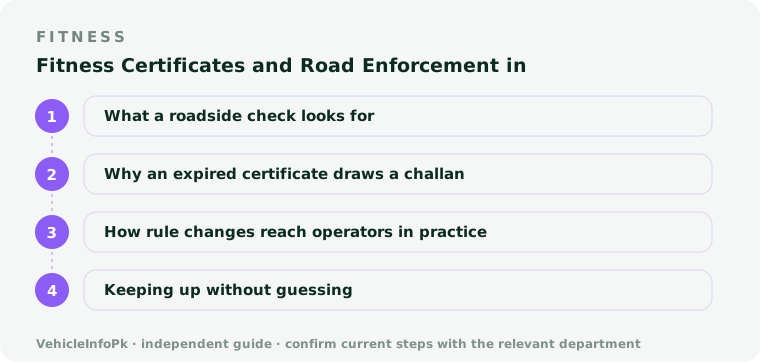
What a roadside check looks for
A routine stop is usually quick. An officer will ask for the driving licence, the registration book or smart card, and proof that the token tax for the current period has been paid. For commercial and public transport vehicles the fitness certificate and route permit are checked as a matter of course; for private vehicles the fitness record is checked where the vehicle class or provincial rules require certification.
| Record checked | Question it answers | Typical consequence if missing or expired |
|---|---|---|
| Driving licence | Is this person licensed for this class of vehicle? | Challan, and possible further action depending on circumstances |
| Registration book or smart card | Whose vehicle is this, and does it match the plate? | Challan, possible impoundment pending verification |
| Token tax receipt | Has the annual road tax been paid? | Challan for the unpaid period, sometimes with arrears demanded |
| Fitness certificate | Is this vehicle roadworthy and inspected? | Challan, and in serious cases the vehicle taken off the road |
| Route permit (commercial) | Is this vehicle licensed to carry passengers or goods here? | Challan and possible action against the permit |
Officers also look at things no document covers: the legibility and format of the number plate, whether lamps work, whether smoke is excessive, and whether the load matches what the permit allows.
Why an expired certificate draws a challan
The reasoning is straightforward. A fitness certificate states that a qualified inspector examined the vehicle on a particular date and found it roadworthy. Once that date passes, nothing on the record shows the vehicle is still safe — brakes wear, tyres age, and suspension loosens. Driving a vehicle with no current certificate means asking the road system to accept an untested vehicle, which enforcement is not designed to do. A challan is therefore issued for the documentary lapse, and separately for safety defects the officer can see, such as dead lamps or visibly smooth tyres.
An expired certificate can complicate an insurance claim after an accident, because the vehicle was being operated without the roadworthiness record it is expected to carry. Keep it current for that reason as much as for the fine.
How rule changes reach operators in practice
Inspection and fitness requirements shift gradually rather than all at once. A province revises its schedule of fitness charges, tightens the standard for a particular vehicle class, adds a new inspection item, extends testing to a category not covered before, or begins accepting bookings through a different channel. In practice these changes reach an operator through several routes:
- Notifications and office circulars issued by the provincial excise and taxation department, posted at excise offices and inspection stations.
- Screens and notices at inspection stations, where revised requirements are usually displayed before they are widely known elsewhere.
- The registration authority's counter, where staff will tell you what the current requirement is when you generate a slip.
- Transport associations and operator unions, which pass new requirements down to members quickly.
- Fleet compliance routines, where a transport manager monitors changes as part of keeping a commercial fleet legal.
Private owners most often learn about a change at the counter, because they deal with the system rarely. Commercial operators cannot afford that lag, so they build monitoring into routine operations rather than waiting to be told.
Keeping up without guessing
Keep one dated folder — physical or digital — holding each vehicle's fitness certificate, token tax receipts, insurance and permits, and set reminders sixty and thirty days before each expiry. Before any compliance deadline, confirm the current requirement directly with the provincial excise and taxation department or the inspection station rather than relying on what applied last year.
Check your own expiry dates against the current provincial requirement this week, and note the next date in a shared calendar. Where a requirement has changed since your last inspection, ask the station to confirm it in writing before you present the vehicle.
Keep reading

How to Apply for a Vehicle Fitness Certificate in Pakistan: Documents, Fee, Inspection and Collection
Apply for a Pakistan vehicle fitness certificate with confidence: documents, fee payment, inspection booking, test day and refusal reasons explained.

Vehicle Fitness Certificate in Pakistan: What It Is, Who Needs One and How It Differs From Registration and Token Tax
A vehicle fitness certificate proves roadworthiness. Learn who needs one in Pakistan, how long it stays valid, and how it differs from token tax.

Fitness Certificate Validity in Pakistan: How Long It Lasts and When It Starts
Fitness certificate validity is set by the authority and differs by class and province. Learn when it starts, when it ends, and the expiry gap.