
Registration
New Vehicle Registration Process in Pakistan: Step-by-Step
Key takeaways
- Each registration step produces a document the next step requires, so the order matters.
- The buyer on the invoice should be the person applying, since records are tied to one CNIC.
- Dealers file most documents, but inspection and fee payment usually fall to the owner.
- Check chassis, engine number and name on the book or smart card before leaving the counter.
A newly purchased vehicle in Pakistan is registered by filing the purchase paperwork, the buyer's CNIC and the application forms with the provincial excise and taxation department, then completing payment, any required inspection, and plate collection. Cars and motorcycles bought from a local dealer are normally registered through the dealer or its agent, while imported vehicles are handled by the owner or a clearing agent. The outcome is a registration number, a set of plates, and a registration book or smart card bearing your name.
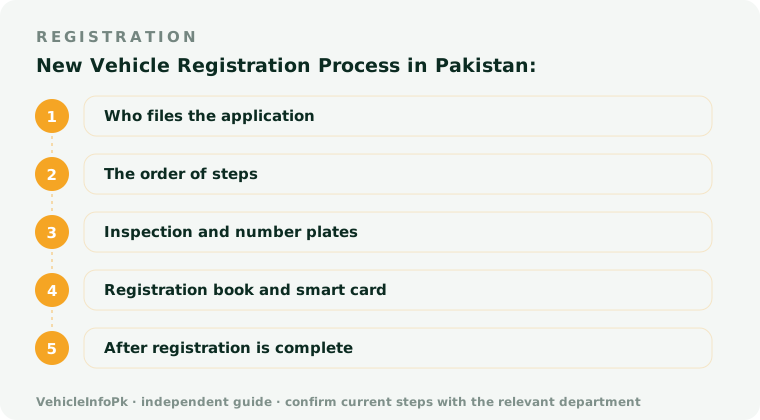
Registration works best when you treat it as a chain of steps, each one producing something the next one needs. Sorting documents, then paying, then inspecting, then collecting plates is almost always faster than paying first and chasing paperwork afterwards.
Who files the application
Responsibility is split three ways, and knowing which part is yours avoids most delays. The dealer issues the sales invoice and delivery documents. You supply identity proof and sign the application. The registration authority verifies the vehicle, records the ownership against your CNIC, and issues the documents.
| Task | Usually handled by | What you should check |
|---|---|---|
| Sales invoice and delivery documents | Dealer or manufacturer | Chassis and engine numbers match the vehicle exactly |
| Application form and CNIC copies | Owner, often filed by the dealer | Name spelled exactly as it appears on the CNIC |
| Customs and import papers | Owner or clearing agent | Duty-paid evidence is attached and legible |
| Fee deposit through the payment slip (PSID) | Owner | Amount is deposited against the correct application or chassis record |
| Physical inspection | Owner attends with the vehicle | Chassis and engine stampings are clean and readable |
The person named on the purchase invoice should be the person applying. Registration records are linked to a CNIC number, and the ownership record follows that identity, so an application that does not match the sale documents will be returned.
The order of steps
Although each provincial department words its instructions slightly differently, the sequence is broadly the same across Punjab, Sindh, Khyber Pakhtunkhwa, Balochistan and the Islamabad Capital Territory.
- Collect the sale documents. Take the original invoice along with the delivery note or sale certificate, and read the chassis and engine numbers off the vehicle itself to compare them with the paperwork.
- Complete the application. Forms are submitted at the registration authority, through the online registration portal where the province offers one, or through the dealer's agent.
- Attach identity proof. A copy of your CNIC plus the supporting documents for the vehicle's origin, whether local manufacture or import.
- Deposit the dues. Issue or collect the payment slip, deposit it through the channel your province nominates, and keep the paid original safely — it is asked for later.
- Present the vehicle for inspection. Where inspection is required, bring the vehicle, the sale documents and the paid slip together.
- Collect plates and ownership document. Plates are issued or collected, and the registration book or smart card is prepared under your registration number.
Inspection and number plates
Inspection exists to confirm that the vehicle physically matches its paperwork. An inspecting officer reads the chassis number, usually stamped on the frame or firewall, and the engine number on the engine block, and compares both against the application. On motorcycles the engine number is often partly hidden by the frame or by accumulated grime, so cleaning it beforehand saves a second visit.
Plates must come from the issuing authority or its authorised agent. Fitting privately made plates before the official set is issued can cause a mismatch between the plate, the registration record and roadside verification systems, and may attract a challan.
Registration book and smart card
Depending on the province and the year of issue, you receive either a paper registration book or a plastic smart card, and some provinces issue both for a period. Whichever you receive, check three things at the counter before leaving: the chassis and engine numbers, your name, and the vehicle description including colour, fuel type and seating or engine capacity.
Corrections are far easier in the first days than months later, because a later correction is handled as a separate application with its own record trail.
After registration is complete
Registration is not the last payment attached to the vehicle. Annual token tax falls due each financial year, insurance where your province requires it must be kept current, and a fitness certificate is a separate requirement for commercial vehicles and for private vehicles past the age threshold set locally. Keep the registration document with copies of your CNIC in a safe place, and photograph it so that you can produce details quickly at a checkpoint.
Once registration is recorded, run a verification of your own registration number to confirm that the record shows your name correctly, then note down the token tax due date for the coming year.
Keep reading
Documents Required for Vehicle Registration in Pakistan
Vehicle registration needs CNIC, sale invoice, origin papers, forms and a paid slip. See what each proves and the remedy when one is missing.
Temporary vs Permanent Vehicle Registration in Pakistan: What Each One Allows
A temporary registration lets you drive briefly while the permanent record is prepared. Learn validity, conversion steps and expired registration risks.
Vehicle Registration Fees in Pakistan: How the Charges Are Built
Registration charges are a bundle of items: entry, plates, documents and provincial levies. See why totals differ and how to verify your amount.