
Fitness
Fitness Certificate for Commercial Vehicles in Pakistan: Inspection Frequency, Route Permits and Compliance Planning

Key takeaways
- Commercial vehicles are inspected more often than private ones, and more often as they age.
- A valid fitness certificate is usually required before a route permit is issued or renewed.
- Track fitness, permit, token tax, insurance and licence dates in one fleet calendar.
- Keep a paper file per vehicle with certificates, receipts and defect lists.
Commercial vehicles in Pakistan are held to a stricter fitness standard than private cars because they carry passengers or goods for payment and spend many more hours on the road. If you operate a bus, van, coach, taxi, truck or goods carrier, a current fitness certificate is not an occasional formality — it is a continuous condition of working legally, and it is closely tied to your route permit.
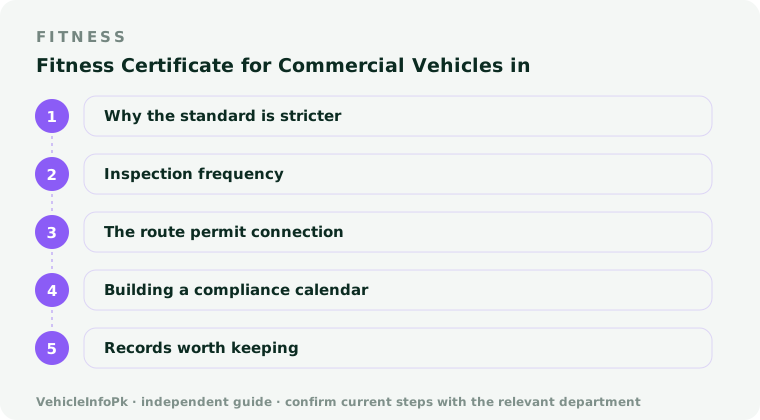
Why the standard is stricter
A private car usually carries one family and covers a limited distance each week. A commercial vehicle may carry dozens of passengers or several tonnes of freight, run daily, and be driven by different drivers. Wear accumulates faster, and the consequence of a mechanical failure is larger. Inspectors therefore look harder at the items that carry that risk: braking performance and balance, tyre condition across all axles, steering and suspension play, lights and reflectors, body and frame condition, load body integrity, emergency exits and passenger fittings, and exhaust smoke.
A commercial vehicle that passes marginally is still a liability. Wear between inspections is real, so operators should treat the certificate as evidence of a baseline rather than as permission to defer maintenance.
Inspection frequency
Commercial vehicles are certified for shorter periods than private ones, and the cycle usually tightens as the vehicle ages. A newer vehicle in good condition may be certified for a year at a time; an older vehicle in heavy service is typically brought back more often. Exact intervals and age thresholds are set by each province — Punjab, Sindh, Khyber Pakhtunkhwa, Balochistan and the Islamabad Capital Territory do not all use the same schedule — so confirm the cycle for your vehicle class and registration province rather than assuming the interval used last year still applies.
The route permit connection
A route permit authorises a vehicle to operate on a defined route or area. It is a separate document from the fitness certificate, but the two are linked in practice: authorities commonly require a valid fitness certificate before a route permit is issued, renewed or allowed to continue. An expired certificate can therefore stop a vehicle from legally working even though the permit itself has not expired.
| Document | Purpose | Typical dependency |
|---|---|---|
| Fitness certificate | Confirms the vehicle is roadworthy | Required before permit issue or renewal in most cases |
| Route permit | Authorises operation on a specific route | Lapses or is withheld when fitness has expired |
| Token tax receipt | Evidence of annual road-use payment | Outstanding dues commonly block both |
| Insurance cover | Covers third-party liability | Often expected alongside permit and fitness records |
Building a compliance calendar
Operators who run more than one vehicle quickly find that expiry dates scatter across the year and that one lapsed certificate can idle a vehicle and its driver. A simple compliance calendar prevents that. Record, for every vehicle in the fleet:
- Fitness certificate expiry date, with a reminder set well before it.
- Route permit expiry and renewal window.
- Token tax period and payment due date.
- Insurance renewal date.
- Driver licence expiry dates, since a vehicle cannot work legally without a licensed driver.
Review the calendar monthly. Booking inspections early also gives you room to fail once, fix the defects and re-present without losing working days.
Records worth keeping
Keep a file for each vehicle containing copies of the registration record, the current and previous fitness certificates, permit documents, token tax receipts, insurance papers, inspection defect lists and repair invoices. At a checkpoint or after an incident, being able to produce organised records immediately is faster and cheaper than arguing from memory.
Start by writing down the fitness expiry date for every vehicle you operate and checking it against your permit renewal date. Any vehicle whose certificate expires before its next scheduled inspection window is the one to book first.
Keep reading

How to Apply for a Vehicle Fitness Certificate in Pakistan: Documents, Fee, Inspection and Collection
Apply for a Pakistan vehicle fitness certificate with confidence: documents, fee payment, inspection booking, test day and refusal reasons explained.

Vehicle Fitness Certificate in Pakistan: What It Is, Who Needs One and How It Differs From Registration and Token Tax
A vehicle fitness certificate proves roadworthiness. Learn who needs one in Pakistan, how long it stays valid, and how it differs from token tax.

Fitness Certificate Validity in Pakistan: How Long It Lasts and When It Starts
Fitness certificate validity is set by the authority and differs by class and province. Learn when it starts, when it ends, and the expiry gap.