
Registration
Vehicle Registration Fees in Pakistan: How the Charges Are Built
Key takeaways
- Your total combines registration, plate, document and tax lines, not one single fee.
- Engine capacity and vehicle class move most provincial charges up or down.
- Each province sets its own schedule, so national figures do not apply everywhere.
- Ask what every line covers and confirm the schedule before depositing anything.
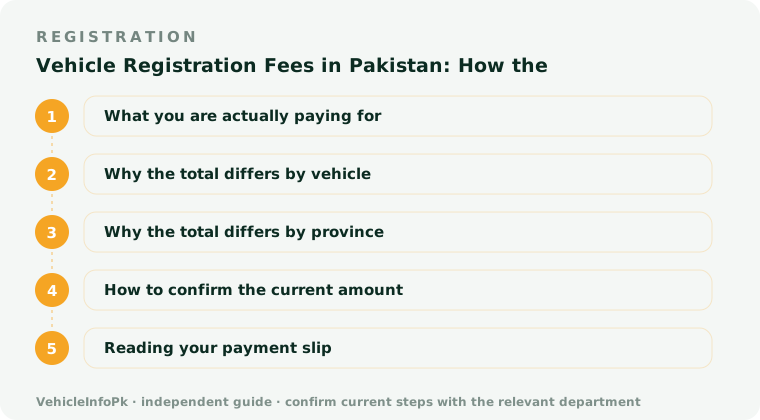
A vehicle registration charge in Pakistan is not one fee but a bundle of separate items listed together on a payment slip: a registration entry charge, a number plate charge, a charge for the registration book or smart card, and any provincial levy or tax due at the time of registration. Because each item is set independently by each provincial excise and taxation department, the same car can attract a different total in Punjab than in Sindh, and a motorcycle is charged differently from a 1300cc sedan. The reliable figure for your vehicle is the one your own provincial department issues against your chassis record, not a number quoted by a dealer or a friend.
What you are actually paying for
| Component | What it covers | How it behaves |
|---|---|---|
| Registration entry charge | Recording the vehicle and issuing a registration number | Often scaled by engine capacity for cars |
| Number plate charge | Production and issue of the official plate set | Higher for official plates in some provinces |
| Registration book or smart card charge | Preparing the ownership document | Smart card and book may be charged separately |
| Token tax | The road tax due for the year | Usually collected at registration, then annually |
| Provincial levies and applicable taxes | Charges set by provincial or federal rules | Vary widely and change between budgets |
| Optional services | Agent handling, delivery, courier | Not part of the statutory charge |
Reading the bundle this way explains something that puzzles many first-time buyers: the amount you pay at registration can be noticeably more than the "registration fee" figure you heard quoted. The quoted figure is usually one line of several.
Why the total differs by vehicle
Two variables drive most of the difference. The first is engine capacity. Several provinces scale both the registration charge and annual token tax by cubic capacity for cars, which is why a 660cc hatchback and an 1800cc sedan sit in different brackets. Motorcycles and scooters generally sit at the lower end of that scale, so their totals are smaller.
The second is vehicle classification. Commercial vehicles, taxis and goods carriers attract their own schedules and often additional documents and dues at the same counter. A vehicle registered for private use but later used commercially will be assessed differently, and that mismatch is worth resolving early.
Why the total differs by province
Provincial governments set their own schedules for registration and token tax, so there is no single national figure. Punjab, Sindh, Khyber Pakhtunkhwa, Balochistan and the Islamabad Capital Territory each publish their own rates, and each revises them at budget time. Islamabad typically follows the national schedule while provinces set theirs independently, which widens the gap further.
Any specific amount printed in a guide, a forum post or a dealer quotation can be out of date before you read it. Treat figures as illustrative only and confirm the current schedule with your provincial department before you deposit anything.
Transfer of ownership, duplicate documents and corrections carry their own separate charges, each set provincially as well. A duplicate registration book, for example, has its own fee line distinct from the original registration charge.
How to confirm the current amount
- Start the application with your own details. Whether through the dealer, an agent or the online registration portal, have a draft application created against your chassis number so the amount is calculated for your specific vehicle.
- Read the itemised breakdown, not only the total. You are entitled to see what each line represents, and inquiring about an unfamiliar line often reveals it belongs to a service you did not request.
- Cross-check against the published schedule. Your provincial excise and taxation department publishes current rates; compare them with the lines on your slip and ask for clarification on any difference.
- Pay only through the nominated channel. Use the payment slip or PSID issued against your own record, and pay at a bank or channel the province names.
- Keep the paid slip with the file. The paid original is evidence at inspection and at plate collection, and later if a record needs reconciling.
Reading your payment slip
A PSID or department-issued payment slip supports both new registrations and later payments such as token tax. It normally shows a reference number, the payee, the amount and a validity period. Depositing after expiry usually means obtaining a fresh slip, so deposit promptly and photograph the paid copy as soon as you have it.
If an amount looks unfamiliar, ask which line it covers and which rule sets it before you pay. That single question resolves most disputes later, because a charge queried at the counter is far easier to explain than one already recorded against your registration number.
Keep reading
New Vehicle Registration Process in Pakistan: Step-by-Step
Registering a new vehicle in Pakistan runs from sale invoice to number plate in six clear steps. See the right order and who files each part.
Documents Required for Vehicle Registration in Pakistan
Vehicle registration needs CNIC, sale invoice, origin papers, forms and a paid slip. See what each proves and the remedy when one is missing.
Temporary vs Permanent Vehicle Registration in Pakistan: What Each One Allows
A temporary registration lets you drive briefly while the permanent record is prepared. Learn validity, conversion steps and expired registration risks.