
Token Tax
Late Token Tax Penalty in Pakistan: Arrears, Surcharge and Clearing Your Record
Key takeaways
- Arrears stay on the vehicle record until the period is actually cleared.
- Late fee structures differ between provinces, so check your own position.
- Unpaid periods surface at transfer, fitness, permit renewal and roadside checks.
- Re-check the record after paying to confirm the periods now show as paid.
When token tax is not paid by its due date, the outstanding period remains on the vehicle record and a late fee or surcharge is added to it under the rules each provincial excise and taxation department publishes. Unpaid dues rarely stay invisible: they surface when you try to transfer ownership, apply for a fitness certificate, or are stopped at a roadside check. This guide explains how the late position works in principle, where arrears are discovered, and how to clear them and get your record straight.
How the late position works
Token tax is assessed for a stated period. Once that period passes without payment, the amount does not simply disappear or reset; it stays on the vehicle as arrears, and a late fee or surcharge is applied on top according to the province's own rules. Because Punjab, Sindh, Khyber Pakhtunkhwa, Balochistan and the Islamabad Capital Territory each publish their own framework, the way the extra charge is expressed differs:
- A fixed late fee per period. Some structures add a set charge for each period left unpaid.
- A percentage-based surcharge. Others calculate the additional amount in proportion to the outstanding tax.
- A rising charge over time. In some cases the additional amount grows the longer the period stays open.
The important point for an owner is structural rather than financial: the arrears and whatever additional charge attaches to them are recorded against the vehicle, not against you personally, so they follow the vehicle until they are cleared.
Do not rely on figures quoted in articles, from dealers or from other owners. Late fee percentages and amounts change and differ between provinces. Generate your challan or ask at the department counter to see exactly what is currently outstanding on your registration number.
Where unpaid dues come to light
An unpaid period usually becomes a problem at the moment you need something else from the department.
- Transfer of ownership. Outstanding token tax is normally cleared as part of the transfer file, so a sale stalls until the arrears are settled. Buyers should therefore check the record before agreeing a price.
- Fitness certificate. A vehicle needing periodic fitness certification has its tax position looked at as part of the process; a gap discovered on inspection day means a failed visit and a rebooking.
- Roadside checks. Traffic staff verify the vehicle record against what you carry, including whether the current period is paid. An open period can lead to a challan and a demand to settle.
- Permit and renewal work. Commercial vehicles applying for permit renewals or related paperwork are checked for arrears at the same time.
- Insurance and financing. Some insurers and lenders ask for evidence that the vehicle's annual charges are current.
Clearing the arrears
- Establish the full outstanding position. Generate the challan or ask at the counter for the periods that are open. Do not assume only the most recent year is due; a gap several years back is common on vehicles that changed hands or sat unused.
- Confirm what the total covers. Check whether the figure shown includes the additional late charge or only the base tax, so you know what you are settling.
- Pay through a route that gives a traceable record. Bank branch, ATM, banking app or the provincial department's own channel all work; keep the generated reference with the payment.
- Keep every receipt. Retain the paid challan or transaction record showing the registration number, the periods covered and the date.
- Re-check the vehicle record afterwards. Confirm the periods now show as paid before you rely on the clearance for a transfer or inspection.
Getting the record straight
Payment and record are two separate things, and clearing arrears is only finished when the record reflects it.
- Allow for posting time. A payment can take a few working days to appear; check again before treating the clearance as failed.
- Watch for a period left open. Paying the current year while an earlier year remains due leaves a gap that will resurface at the next transaction.
- Take proof to the department where a mismatch persists. A traceable reference and paid challan are enough for staff to trace a payment and reflect it against the vehicle.
Staying ahead of the deadline
Most arrears arise from small household changes rather than from any deliberate decision. A vehicle kept off the road, a move between cities, a registration book misplaced during a house shift, or an assumption that a dealer or a relative settled the bill all lead to the same outcome.
- Set a reminder against your own renewal period each year, including time for a payment to post before you need proof.
- Keep a single folder, physical or digital, with the registration book copy, CNIC copies and every challan.
- Check the record before any planned sale, inspection or long trip, rather than waiting for someone else to find the gap.
Start by getting the exact outstanding position for your registration number, including any additional late charge, then pay through a traceable route and keep the proof. Confirm a few working days later that the periods show as paid, so nothing is left waiting to surprise you at a transfer or fitness inspection.
Keep reading
Token Tax in Pakistan: What It Is, Who Pays and How It Is Calculated
Token tax in Pakistan is the annual provincial road tax on a registered vehicle, charged by engine size or category. Rates differ in every province.
How to Pay Token Tax in Pakistan: Branch, Online Banking and Portal
Pay token tax in Pakistan by bank payment slip, online or mobile banking, or the provincial portal. Always keep the paid challan as proof of payment.
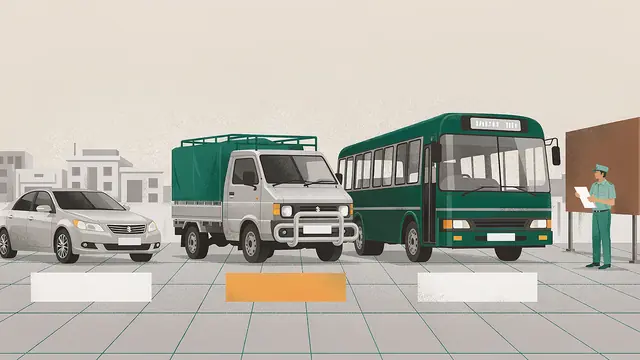
Token Tax Categories in Pakistan: Private, Commercial and Public Transport Vehicles
Token tax categories in Pakistan split private, commercial and public transport vehicles into separate provincial schedules with different annual rates.