
Token Tax
Token Tax Categories in Pakistan: Private, Commercial and Public Transport Vehicles
Key takeaways
- The class printed on your registration record decides which part of the schedule applies.
- Private cars are rated in engine capacity bands, so small cc differences can matter.
- Goods and passenger vehicles are assessed on weight or seating capacity instead.
- Each province publishes its own schedule, so confirm rates locally before paying.
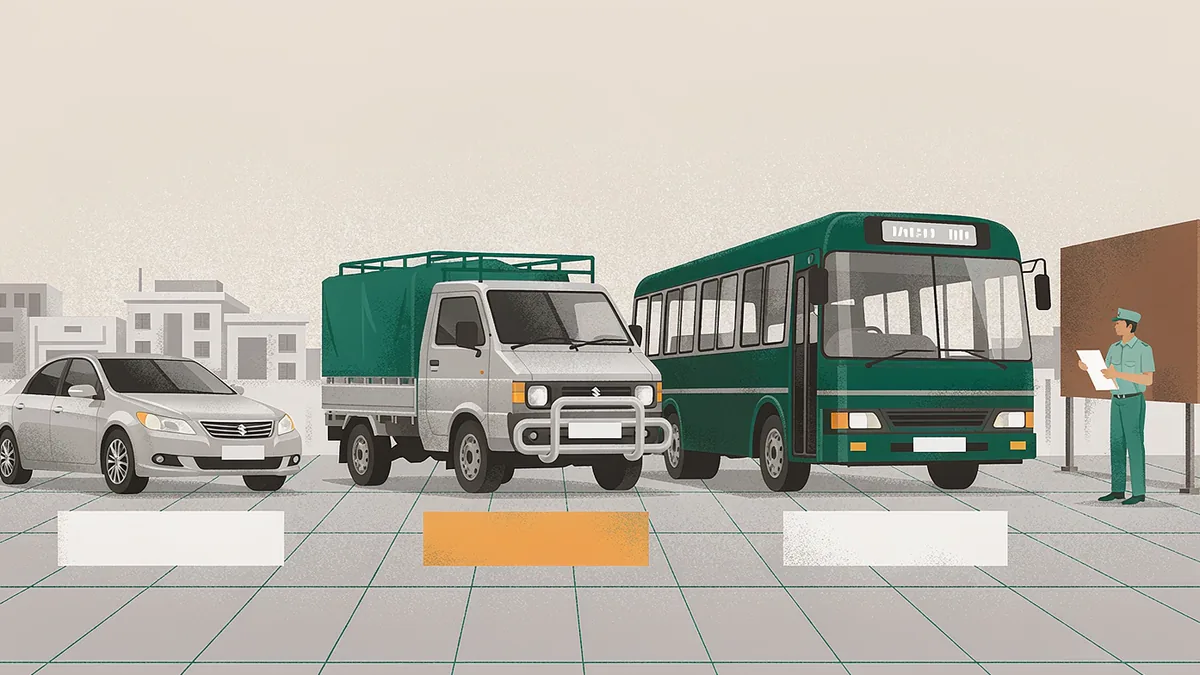
Token tax in Pakistan is divided into vehicle categories, and each category carries its own annual rate under a schedule published by the provincial excise and taxation department. Private cars and motorcycles sit in one set of bands driven mainly by engine capacity, while commercial goods vehicles and public transport passenger vehicles are assessed on a different basis such as weight or seating capacity. This guide explains how those categories are structured, how the engine capacity bands work, and why two vehicles bought in the same year can be charged different amounts.
How token tax categories are set
A vehicle does not choose its category when the bill is generated. The category is fixed by what is recorded at registration, and the department's system reads those fields when it produces your challan or PSID.
- Vehicle class. Every registration record carries a class that shows whether a vehicle is registered for private use, for carriage of goods, or as a public service vehicle. This single field decides which part of the schedule applies.
- Engine capacity. For privately registered cars, jeeps and similar vehicles, capacity in cubic centimetres (cc) is the main rating factor.
- Weight or seating capacity. For goods and passenger vehicles, schedules usually work from laden or unladen weight, or from the number of seats recorded, rather than engine size.
- Declared use. A vehicle that carries a route permit and operates for hire sits in a commercial or public service category even if it looks like an ordinary car on the road.
Each province publishes its own schedule. The same vehicle class with the same engine capacity carries a different annual charge in Punjab, Sindh, Khyber Pakhtunkhwa, Balochistan and the Islamabad Capital Territory. Confirm the current schedule with your own provincial excise and taxation department before you pay.
Private vehicles and engine capacity bands
Private vehicles are usually rated in consecutive capacity bands rather than on a flat per-cc calculation. A lower capacity sits in the lowest band, higher capacities move up through the bands, and each band carries its own annual amount. The practical consequences of a band structure are worth understanding:
- It is a step structure, not a smooth one. Two vehicles with similar engine sizes often fall in the same band and pay the same amount, while a small increase in cc across a boundary moves the vehicle into the next band entirely.
- The band boundaries differ by province. A size that falls at the top of one band in one province may fall near the bottom of another, so comparing with a friend in another province tells you little.
- The capacity on the record is what counts. What matters is the figure printed on the registration book or smart card, not the brochure figure for the vehicle line.
- Separate treatment exists for some drivetrains. Several provinces treat hybrid or electric private vehicles differently from conventional petrol and diesel ones, and some treat certain locally assembled categories separately.
Commercial and public transport vehicles
A goods vehicle and a passenger vehicle are assessed on what they carry rather than on how big their engine is. That reflects their heavier use of the road network and their earning role, and it also draws them into a wider set of recurring obligations.
| Vehicle group | Usual assessment basis | Other recurring items |
|---|---|---|
| Private car, jeep, SUV | Engine capacity band | None annually beyond token tax |
| Motorcycle, scooter | Engine capacity band, lowest set | None annually beyond token tax |
| Goods vehicle, pickup, truck | Weight class recorded at registration | Fitness certificate, route permit where applicable |
| Bus, wagon, van, taxi | Seating capacity or service class | Fitness certificate, route permit, insurance conditions |
| Rickshaw, three-wheeler | Own class within the passenger schedule | Fitness and permit requirements by province |
Why two vehicles of the same year differ
Two cars bought in the same year and kept in the same city can carry different annual token tax for several ordinary reasons.
- Different engine variants. A single vehicle line often ships more than one engine size, and that difference is enough to cross a band boundary.
- Different registered class. One registered for private family use and one registered for commercial carriage sit in different schedules even where the mechanical vehicle is similar.
- Different registering province. Where a vehicle was first registered determines which schedule it follows.
- Different drivetrain treatment. Hybrid and electric versions attract different treatment in several provinces.
- Different registration date. That sets which period falls due and whether the first charge covers a full year or part of one, which changes the amount on the first bill rather than the category itself.
Confirming which category applies
- Read the registration record. The class and the engine capacity printed on the registration book or smart card are the starting point.
- Generate the challan before paying. The PSID or payment slip normally states the vehicle description, the period and the amount; read those lines before you hand over money.
- Compare the description with your record. If the challan describes your vehicle in a class that does not match the book, stop and get the record checked.
- Correct the classification at source. A wrong class is a correction at the registration authority, not something to settle by paying whatever the slip shows.
Read the class and engine capacity printed on your registration book or smart card, then generate the challan and check the category it applies before paying. Where the two disagree, have the registration record corrected first so the right schedule follows the vehicle for every year that remains.
Keep reading
Token Tax in Pakistan: What It Is, Who Pays and How It Is Calculated
Token tax in Pakistan is the annual provincial road tax on a registered vehicle, charged by engine size or category. Rates differ in every province.
How to Pay Token Tax in Pakistan: Branch, Online Banking and Portal
Pay token tax in Pakistan by bank payment slip, online or mobile banking, or the provincial portal. Always keep the paid challan as proof of payment.
Late Token Tax Penalty in Pakistan: Arrears, Surcharge and Clearing Your Record
Late token tax arrears stay on the vehicle record until cleared. Learn where unpaid dues surface, then how to settle them and fix the record.